
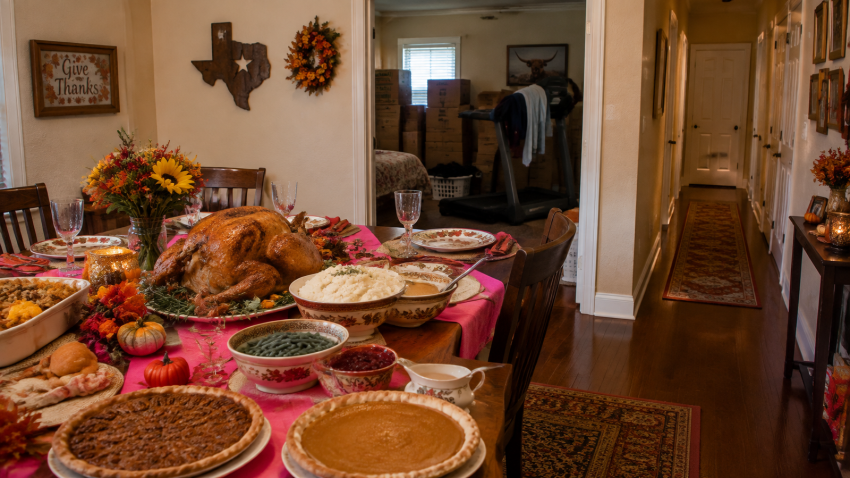
Every year on the fourth Thursday of November, Katy turns into one giant open house. The kids fly in from Austin and Denver and somewhere with a time zone, cars line both sides of the street (nobody parks on the grass here unless they want to pay for new sprinkler heads), and for about four hours a family walks through Mom and Dad’s house like a buyer at a showing. Nobody calls it that. But trust me, that is exactly what is happening.
Somewhere between the green bean casserole and the second slice of pecan, somebody notices something. The stairs. The yard. The garage nobody has been able to park in since about 2015. And on the drive home, the kids say it out loud for the first time: “Is the house getting to be too much for them?”
I call it the Thanksgiving Walk-Through, and it is one of the most common ways a family downsizing conversation gets started. So whether you are the one hosting the whole crew or the one flying in for the weekend, here are seven things the house is trying to tell your family this holiday, and how to have the conversation without ruining dessert.
1. The stairs always tell on everybody
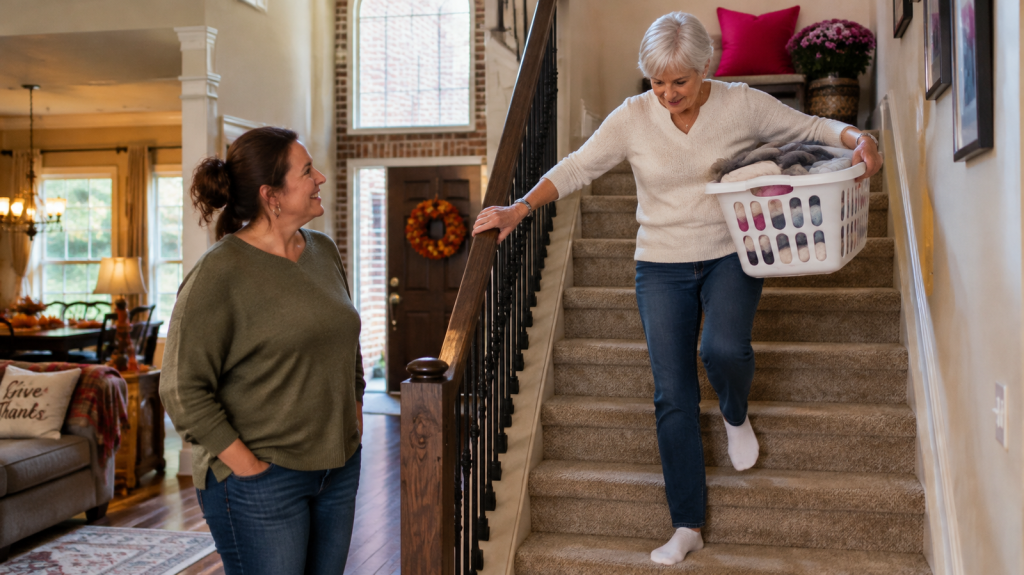
Watch the stairs. If the laundry room is upstairs and the laundry basket is coming down one careful step at a time with a death grip on the rail, the house just said something. If the primary bedroom is upstairs and Dad has quietly started sleeping in the downstairs study “because it’s cooler,” the house said it louder.
Katy is full of beautiful two-stories built for families with a teenager in every bedroom and knees that never complained. That house did its job. It does not owe anybody another twenty years of stairs.
2. Count the closed doors
Walk the hall and count the doors that stay shut. The old bedrooms that turned into the “storage room,” the “craft room,” and the room where the treadmill went to become a coat rack. Every one of those rooms is still being cooled in August, still being taxed, and still being dusted (or not, no judgment).
Closed doors are not a crisis. They are a clue that the house is bigger than the life happening inside it. And if what is behind those doors is mostly stuff, we already wrote the survival guide: It Was Never About the House. It’s the Stuff.
3. Look at the yard, then ask who is doing it
Gutters full of leaves. A pool that turned a shade of green not found in nature. The fence board that has been “about to get fixed” since spring. Then ask the real question: who is doing all this now? If the answer is “Dad, on a ladder,” or “the yard guy quit in June,” the house is talking again.
A big lot was a dream at 45. At 75 it can turn into a part-time job with no paycheck.
4. Do not have the talk at the table
Listen to me. Do not bring up selling the house between the turkey and the pie with the whole family watching and Uncle Ray offering opinions nobody asked for. Nothing makes a parent dig in faster than feeling ambushed at their own table. That is how a reasonable idea turns into “I’m not going anywhere until they carry me out,” and now it is personal.
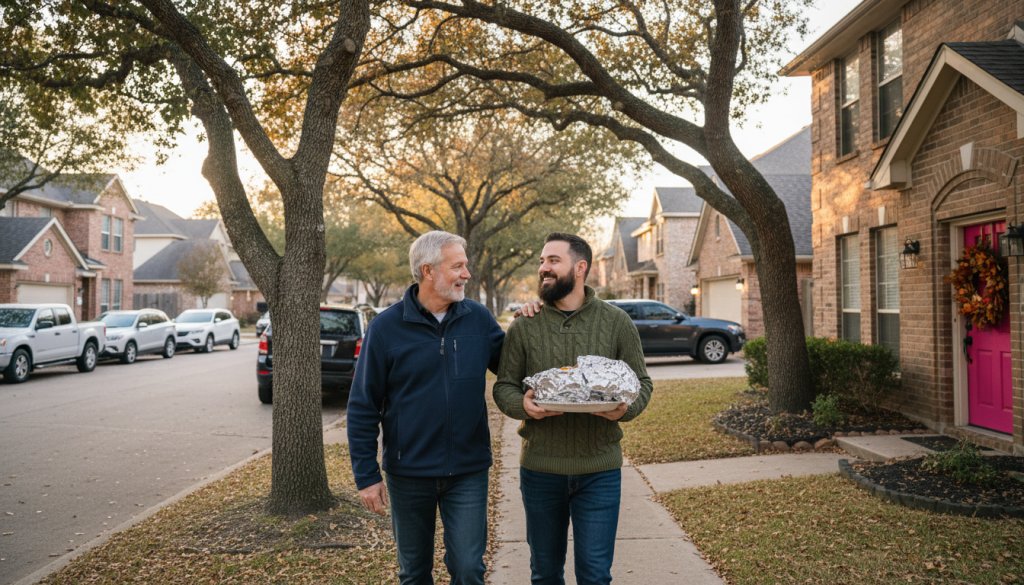
Have it on the walk to the car instead. With cars lined up down the whole street, yours is parked three houses down anyway. Just the two of you, with you carrying the foil-wrapped plate of leftovers Mom insisted you take home. People say a lot more side by side than they ever will across a table.
5. Ask questions. Do not make announcements.
“You need to sell this house” is an announcement. “What part of the house has gotten harder?” is a question. One starts a fight. The other starts a conversation.
Try these on the walk. “If you could change one thing about the house, what would it be?” “Do you ever think about a one-story?” “What would you want to do with all this space if it were up to you?” Then hush and listen. Their answers are the plan. Your job is to hear it.
6. Parents, here is your secret weapon: go first
Now for the folks hosting the whole crew. You already know your kids are going to look around. So beat them to it. Bring it up yourself, on your terms, before anybody gets to “walk-through” you. “We’ve been thinking about what’s next for this house” is the most powerful sentence you can say at Thanksgiving. Nobody can take over a conversation you started.
And if the thing keeping you put is the fear of losing your over-65 tax freeze, sit down and read You CAN Take It With You before the turkey even thaws.
7. Leave with facts, not feelings
The best thing a family can take home from Thanksgiving is not a decision. It is a plan to get real numbers. What is the house actually worth today? What would a one-story in Katy, Fulshear, or one of the 55+ communities really cost? How long would it all take, and who handles the sorting and the moving?
That is where I come in. I bring the numbers and guide the strategy, and I have people for the heavy lifting, from the sorting to the boxes to the truck. Nobody has to decide anything over pie. You just have to agree to find out. If you want a head start on the downsizing math, The Katy Rightsizing Diet is a good place to begin.
So this Thanksgiving, eat the pie, watch the stairs, count the doors, and save the big talk for the walk to the car. The house has been telling your family something for a while now. It is okay to finally listen. And when you are ready for a conversation, that part is free, and I will bring the calculator. You know where to find me.
Downsizing After the Holidays FAQ
Not at the holiday table. Pick a quiet moment with just one or two people, like a walk after dinner, and start with questions about what has gotten harder instead of announcing that they need to move.
Common clues are stairs they now avoid or take very carefully, rooms that stay closed and unused, yard and pool upkeep falling behind, and a primary bedroom upstairs that is no longer practical.
It often goes better that way. Starting the conversation yourself lets you set the terms and share your own plans, so nobody feels like decisions are being made for them.
Not necessarily. A Texas homeowner 65 or older can transfer the school tax ceiling to a new homestead as a percentage. It has to be requested from the appraisal district, so confirm the details with the county appraisal district and a tax professional.
Get real numbers: what the current home would sell for today, what a smaller home or one-story would cost, and the timeline and help needed for sorting and moving. A conversation with a local agent is a free place to start.
Yes. The Katy, Fulshear, and Richmond area has several active adult communities with one-story homes, plus plenty of one-story options in regular neighborhoods for families who would rather not age-restrict.