
By Mickie Cioccia, Broker Associate & CDRE (Certified Divorce Real Estate Expert), eXp Realty
I want to tell you about a phone call I get more often than you would believe. It usually comes a year or two after the divorce is final. The ink is dry, everyone has moved on, and then someone goes to buy a car, or a house, or just pulls their credit report. And there it is. The mortgage. The one on the house they gave up. The one they were absolutely, positively sure was not their problem anymore.
Surprise. It was their problem the whole time.
This is the third post in my series on divorce and the house here in Katy. If you missed the first two, start with who keeps it, who sells, and how to handle it without losing your mind, then read whether to sell before, during, or after the divorce. Today we are getting into the part that wrecks people after everything is supposedly settled: the difference between the deed and the mortgage, and the seven things almost everyone gets wrong about it.
1. The deed and the mortgage are two completely different documents
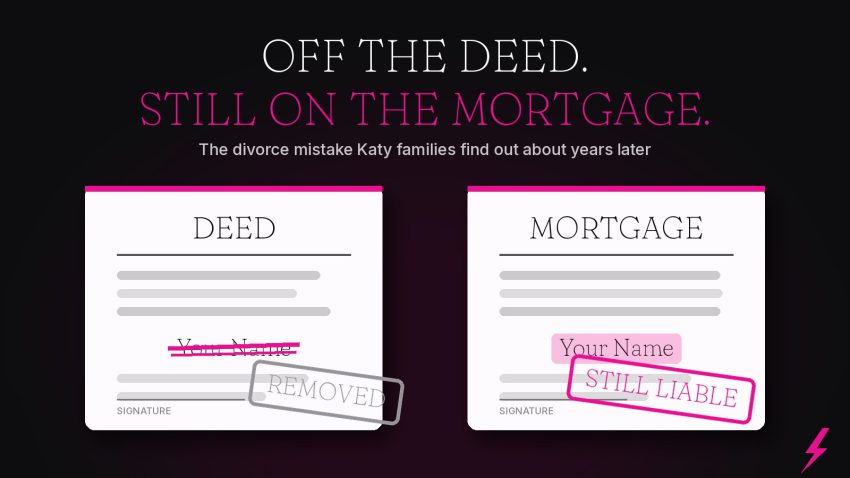
This is the big one, so let’s nail it down. The deed says who owns the house. The mortgage says who owes for the house. They are two separate pieces of paper, signed for two separate reasons, and changing one does absolutely nothing to the other.
So yes, you can sign a deed handing your ownership to your ex and still be 100% on the hook for the loan. Your name off the deed means you gave away the asset. It does not mean you gave away the debt. The bank did not sign your divorce papers, and the bank does not care about them. Which brings us to number two.
2. “The decree says he pays it” means nothing to your lender
Your divorce decree is an agreement between you and your ex, blessed by a judge. Your lender was not in that courtroom. Your lender is not a party to that agreement. As far as the mortgage company is concerned, the two names on the note are the two people who owe the money, decree or no decree.
If the decree says your ex pays the mortgage and your ex stops paying, the lender comes after both of you. Your credit takes the hit right alongside theirs. The decree gives you the right to drag your ex back to court, which is a fine consolation prize while your credit score is doing a swan dive. The court can punish your ex. It cannot un-ding your credit.
3. Signing over the deed without a refinance is the worst of both worlds
In Texas divorces, the spouse leaving the house usually signs a special warranty deed handing their ownership interest to the spouse who stays. Fine. Normal. Expected. But if that deed gets signed and no refinance ever happens, look at what you just did: you gave up every right to the house and kept every bit of the liability.
You cannot sell it. You cannot live in it. You cannot make decisions about it. But if the roof caves in on that loan, financially speaking, you are standing right under it. The deed and the refinance should travel together like teenagers at the mall. If someone is asking you to sign the deed “now” and refinance “later,” that is a conversation to have with your attorney before your pen ever comes out.
4. The owelty lien is the Texas tool almost nobody explains
Here is one you have probably never heard of, and it might be the most useful thing in this whole post. Texas has something called an owelty of partition lien. In plain English: it is a lien written into the divorce paperwork that lets the spouse keeping the house refinance and pull money out to pay the other spouse their share of the equity, without slamming into the tight restrictions Texas puts on regular cash-out refinances.
Done right, an owelty lien can let the staying spouse borrow against more of the home’s value than a standard Texas cash-out allows. But here is the catch: it has to be created correctly and it has to be created early, in the decree itself. You cannot bolt it on after the fact because someone forgot. This is exactly why the real estate conversation belongs at the divorce table from day one, not after the judge signs. Your attorney and your lender both need to be in on this play.

5. Refinance deadlines are real, and qualifying alone is a whole different ballgame
Many decrees give the staying spouse a deadline to refinance, often somewhere between 90 days and a couple of years. People treat that deadline like a gym membership resolution. It is not. It is a court order.
And here is the part that catches people off guard: the household qualified for that mortgage on two incomes, at whatever rate existed back then. The refinance happens on one income, at today’s rate. Sometimes the math works. Sometimes it flat out does not, and no amount of wanting the house changes what the lender’s calculator says. Before anyone fights to keep the house, someone should be advising them to talk to a lender and find out whether keeping it is even on the menu. That is a conversation I set up for my clients before emotions and attorneys’ fees get spent on a house that was never keepable.
6. That old mortgage follows you to your next house
Ready to start your next chapter and buy your own place? Wonderful. Except your name is still on the old mortgage, and your new lender can count that whole payment against you when they calculate how much you can afford. Some loan programs will set that payment aside when the decree clearly assigns it to your ex. Others want to see months of proof that your ex actually pays it, on time, from their own account. Every lender handles it a little differently, and none of them handle it by pretending the old loan does not exist.
Translation: that lingering mortgage can shrink your buying power or stall your purchase entirely. If a fresh start is the goal, getting your name truly off the old loan is step one, not an afterthought.
7. Only three exits actually take your name off the loan
Let’s end with the only list that matters. There are exactly three ways your name comes off a mortgage. One, the house is refinanced in your ex’s name alone. Two, the house is sold and the loan is paid off. Three, the lender approves a formal assumption, where your ex officially takes over the existing loan and you are released in writing.
That third one sounds dreamy, especially if the existing loan has one of those beautiful low rates from a few years back. Just know that assumptions are slower and rarer than people think, the ex has to qualify on their own, and the release of liability is the part you fight for. An assumption without a written release of your liability is just the old problem wearing a new outfit. “He said he would handle it” is not on the list. “The decree covers it” is not on the list. Refinance, sale, or formal assumption with a release. Pick one, get it done, get your name back.
The bottom line
Divorce is hard enough without a financial booby trap going off two years later. The deed and the mortgage are not the same thing, the decree does not protect your credit, and the only real exits are refinance, sale, or a formal assumption. Every one of those works best when it is planned during the divorce, not discovered after it.
This is exactly the corner of real estate my CDRE training covers. I work alongside Katy families and their attorneys as the guiding light through the house piece of a divorce, so nobody signs away an asset while keeping the debt, and nobody finds a surprise on a credit report down the road. If you or someone you love is staring down this situation, call me at 281-717-4412 or find me at CallMickieC.com. And one important note: I am a real estate broker, not an attorney or a lender, so for the legal and loan specifics of your situation, your attorney and your loan officer are your people. I will happily work right beside them.
Frequently Asked Questions
No. The decree is an agreement between you and your ex. Your lender is not a party to it, and both names stay on the loan until the house is refinanced, sold, or formally assumed with a release of liability.
An owelty of partition lien is a Texas tool written into the divorce paperwork that lets the spouse keeping the house refinance and pull out equity to pay the other spouse their share, without the tight limits of a standard Texas cash-out refinance. It must be set up correctly in the decree, so raise it with your attorney and lender early.
Sometimes, but formal assumptions are slower and rarer than people expect. Your ex has to qualify on their own, the lender has to approve it, and you need a written release of liability. Without that release, your name and your risk stay on the loan.
If your name is still on the loan, every late payment reports on your credit too, no matter what the decree says. You can take your ex back to court, but that does not repair your credit score.
Maybe, but it is harder. Your new lender can count the old payment against you when calculating what you can afford. Some programs set it aside when the decree assigns the debt to your ex, while others want months of proof your ex pays it. Talk to a lender before you fall in love with a new house.
Often, yes. A sale pays off the loan, releases both names, and turns the equity into cash both spouses can use for their next chapter. Whether selling is the right move for your situation is exactly the kind of question a CDRE can help you and your attorney think through.
Related reading: Divorce and the House: Who Keeps It, Who Sells, and How to Handle It Without Losing Your Mind and Selling the House in a Katy Divorce: Before, During, or After?